


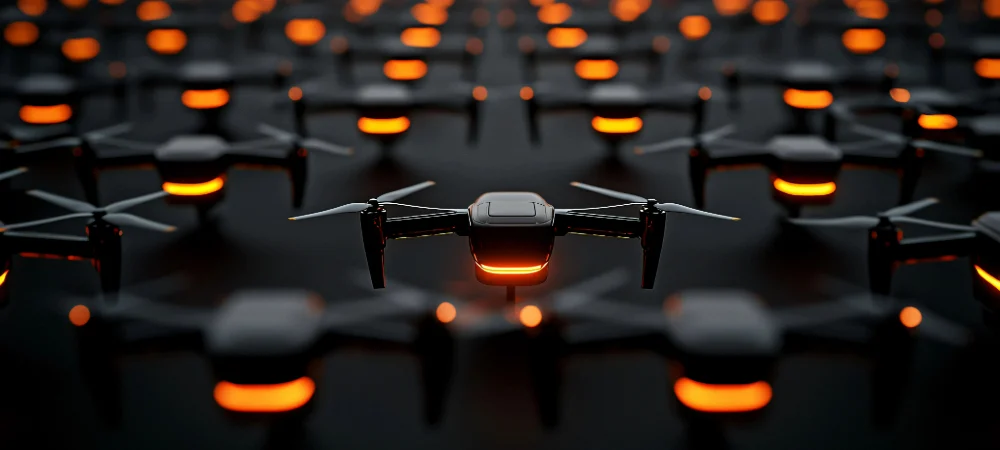
Combined solution enables aerial platforms to detect, track and engage terrestrial and maritime targets, pairing SwarmOS edge-based perception, collaboration and multi-target coordination with NORDA’s combat-proven systems.
Palladyne AI, a US-based defense and industrial technology company delivering embodied AI-powered collaborative autonomy solutions, and NORDA Dynamics (NORDA), a Ukrainian-Estonian developer of a drone autonomy ecosystem proven in active combat, are collaborating to integrate Palladyne AI’s SwarmOS decentralized, collaborative autonomy platform with the Underdog Autonomy Module, NORDA’s autonomous terminal guidance product for next-generation unmanned swarm operations.
Founded in 2024, NORDA Dynamics is a defense-tech company with its engineering and operations center in Lviv, Ukraine. NORDA builds its products on Underdog CORE, an AI brain that gives drones GNSS-denied navigation, target recognition, terminal guidance and onboard decision-making, enabling them to complete missions without GPS, without communications and amid active electronic warfare, across strike and interception roles.
These systems are among the most widely deployed today in active combat zones: integrated with dozens of drone manufacturers in Ukraine and tested in tens of thousands of real-world engagements on one of the world’s most electronically contested battlefields. That record is what NORDA brings to the collaboration.
The two companies’ technologies are complementary, addressing different phases of the same mission. SwarmOS provides the swarm intelligence layer: distributed, edge-based perception and collaboration that lets multiple unmanned platforms autonomously detect, classify, assign and maintain persistent tracking of multiple moving or stationary targets at once.
Underdog takes over for the final phase – short-range precision pursuit and engagement of each assigned target, even when jamming has disrupted communications with the UAV. Each system is designed to operate independently within its own phase of the mission.
When integrated together, SwarmOS’ persistent, multi-target tracking can feed real-time target state data directly into NORDA’s terminal guidance, enabling the combined system to autonomously find, fix, track, assign, pursue and guide capability against multiple simultaneous targets, with decentralized coordination and minimal operator workload. Throughout the mission, engagement decisions remain subject to human-on-the-loop oversight.
The collaboration pairs two complementary autonomy ecosystems: SwarmOS extends its platform-agnostic swarming architecture into autonomous terminal guidance for counter-unmanned aircraft systems (C-UAS), while the NORDA Ecosystem gains a collaborative, multi-target coordination layer for its combat-proven autonomy products.
Under the collaboration and subject to any necessary governmental approvals, the companies plan to integrate their technologies onto one or more unmanned platforms and jointly demonstrate the combined system.
The same framework extends to countering adversarial unmanned aerial systems, using coordinated multi-vehicle sensing, tracking and interception. Distributed decision-making and onboard artificial intelligence are designed to keep the integrated architecture resilient even when communications are degraded or denied.
The collaboration aligns with US Department of War modernization priorities: a shift toward low-cost, distributed and attritable capabilities under the Department’s cost-per-effect mandate, expanding investment in counter-unmanned aerial systems and treating collaborative autonomous swarming as a current operational requirement rather than a future concept.
Ben Wolff, President and CEO, Palladyne AI, said: “NORDA has proven in combat, at scale, that terminal guidance can survive jamming and GPS denial, addressing one of the hardest problems in electronic warfare. SwarmOS turns that proven guidance into a collaborative force – a heterogeneous swarm that finds, tracks and assigns multiple targets at once, then hands each one off for terminal engagement, on its own, without constant communications or a single operator flying every asset. This is how you go from a single weapon that survives the fight to a swarm that wins it.”
Nazar Bigun, Co-Founder and CEO, NORDA Dynamics, said: “We built the NORDA Ecosystem to solve autonomy across the whole mission – navigation when GPS is gone, recognition when communications are jammed, and terminal guidance when everything else has been taken away. Underdog is the sharpest edge of that ecosystem, proven across tens of thousands of real deployments. Palladyne AI’s SwarmOS has demonstrated that unmanned platforms can operate as a collaborative team without centralized control. Bringing our guidance into that architecture means each vehicle in the swarm reaches its assigned target, while the swarm as a whole adapts together. Proven precision plus proven collaboration – exactly what operators need next.”

